South Perth, Western Australia
August 18, 2010
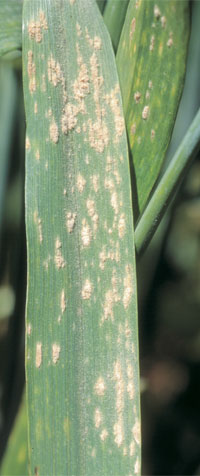 Growers can rest assured there are still fungicide options capable of combating barley powdery mildew despite the recent finding of a triazole resistant strain of the fungal disease in the Great Southern region of Western Australia.
Department of Agriculture and Food plant pathologist Kith Jayasena said recent department trials funded by the Grains Research and Development Corporation (GRDC) on the south coast had demonstrated a range of registered fungicides could control powdery mildew.
“In recent years, powdery mildew has been a consistent problem for WA malt barley growers and the prospect of powdery mildew developing resistance has been a concern to the department for some time,” Dr Jayasena said.
“In preparation we recently carried out research trials testing a wide range of registered fungicides for their ability to control powdery mildew, so growers could use alternative fungicides with confidence if and when powdery mildew resistance emerged.”
The research showed newer triazole fungicides and fungicides with alternative modes of action are effective against powdery mildew.
These include fungicide mixtures with different active ingredients such as azoxystrobin with cyproconazole; propiconazole with cyproconazole; prothioconazole with tebuconazole; epoxiconazole with pyraclostrobin, and epoxiconazole itself, which were all effective in controlling powdery mildew.
Some of the active ingredients such as tebuconazole and propiconazole by themselves were less effective in powdery mildew control, Dr Jayasena said.
“Growers concerned about powdery mildew resistance are advised to rotate a range of fungicides to minimise the selection pressure for resistant strains of the fungal disease,” Dr Jayasena said.
While many growers achieve excellent mildew control with the older triazoles (propiconazole and tebuconazole), Dr Jayasana said it was best to minimise the number of applications of these chemicals used in a season, particularly if these fungicides have performed poorly in terms of mildew control.
The resistant powdery mildew strain, identified by plant pathologist Richard Oliver of Curtin University, is Australia’s first confirmed case of fungicide resistance in a broadacre crop pathogen and highlights the need for growers to avoid overuse of pesticides.
“Herbicide overuse led to herbicide resistant weeds so it is not surprising that the widespread use of triazoles has led to a resistant fungal strain,” Dr Jayasena said.
Dr Jayasena said it was understandable that growers who regularly faced high levels of powdery mildew in susceptible varieties had taken advantage of the low cost of fungicides in recent years and used them more often and more extensively to combat disease.
“However, to minimise selection pressure for further fungicide resistance it is important to use fungicides strategically and also to use fungicides with different modes of action,” Dr Jayasena said.
“Using barley varieties with good resistance to powdery mildew is undoubtedly the best longer term strategy to manage the resistance issue.”
Picture caption: Department of Agriculture and Food research shows there are still many effective fungicide options against barley powdery mildew despite the recent finding of a resistant strain of the costly fungal disease.


 Species