


|
New AI model that determines whether tomatoes are ripe for picking
Israel
A new AI model using hyperspectral imaging to assess pre-harvest tomato quality, which can ultimately be used in a low-cost, portable device, has been developed by Hebrew University of Jerusalem researchers. According to the study in Computers and Electronics in Agriculture, a cost-effective, non-destructive method to predict key quality parameters, including weight, firmness, and lycopene (a natural antioxidant) content, enables farmers to monitor fruit development in real-time, optimizing harvest timing and improving crop quality. The research demonstrates a significant leap forward in precision agriculture and sustainable food production. “Our research aims to bridge the gap between advanced imaging technology, AI, and practical agricultural applications,” said Dr. David Helman from the Hebrew University Robert H. Smith Faculty of Agriculture, Food, and Environment. “This work has the potential to revolutionize quality monitoring not only in tomatoes but also in other crops. Our next step is to build a low-cost device (ToMAI-SENS) based on our model that will be used across the fruit value chain, from farms to consumers.” Hyperspectral images of light wavelengths, known as spectral bands, are used to study objects’ properties based on how they reflect light. This approach focused on fruit addresses challenges associated with traditional methods, offering a faster, non-destructive, and cost-effective alternative.
The study, conducted in collaboration with researchers from Bar-Ilan University and the Volcani Center, used a handheld hyperspectral camera to collect data from 567 tomato fruits across five cultivars. Machine learning algorithms, including Random Forest and Artificial Neural Networks, were employed to predict seven critical quality parameters: weight, firmness, total soluble solids (TSS), citric acid, ascorbic acid, lycopene, and pH. The models demonstrated high accuracy, with the Random Forest algorithm achieving an R² of 0.94 for weight and 0.89 for firmness, among others. Key findings of the study include:
The study highlights the potential integration of this technology into agricultural practices, from smart harvesting systems to consumer tools for evaluating produce quality in supermarkets. The research paper titled “Machine learning models based on hyperspectral imaging for pre-harvest tomato fruit quality monitoring” is now available in Computers and Electronics in Agriculture and can be accessed here. Researchers: Institutions: More solutions from: Hebrew University of Jerusalem Website: https://en.huji.ac.il/ Published: March 4, 2025 |
|
|||||
|
|


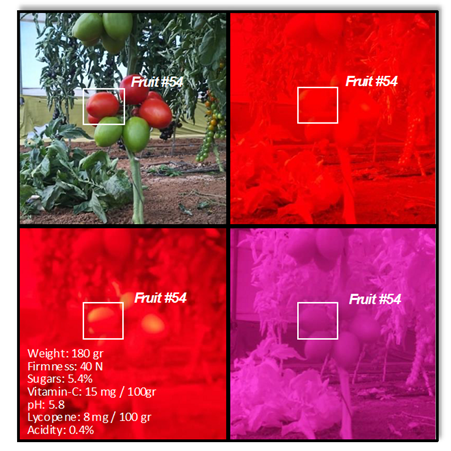 ToMAI-SENS imaging of the fruits at different bands, identifying the fruit and estimating its quality parameters. | Credit: Yedidya Harris